
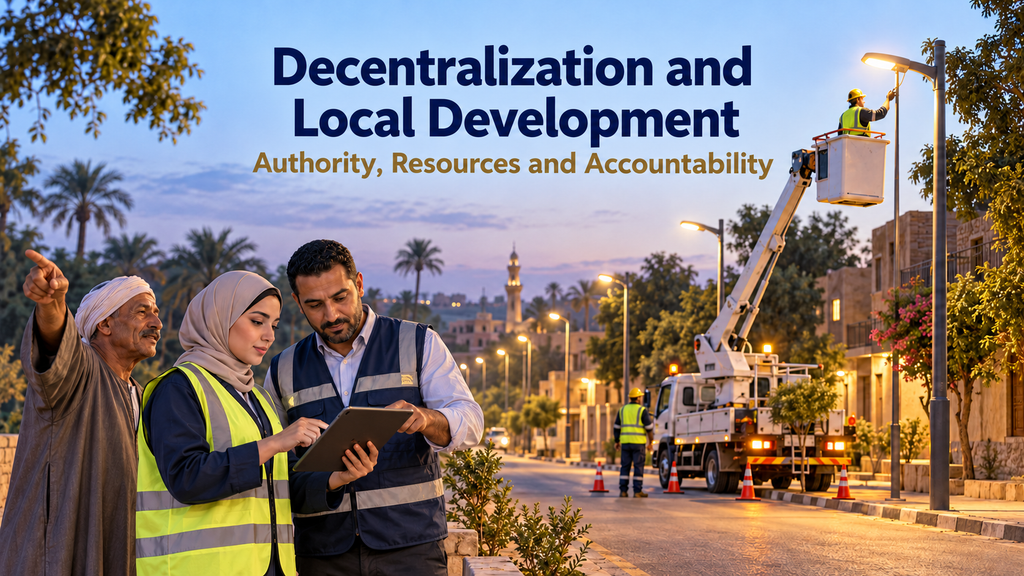
The relationship between decentralization and local development becomes practical when we ask who can make decisions about a public service, whether that person has the resources to act, and how results are reviewed.
A local official may understand a problem but have limited authority or insufficient resources. Wider powers may also coexist with overlapping responsibilities or weak oversight. Bringing decisions closer to citizens therefore requires arrangements that connect authority with resources, capability, and accountability.
This article explains general concepts through a hypothetical village streetlight maintenance case. It does not assign legal responsibilities to particular Egyptian institutions. Actual mandates depend on the legislation, regulations, and service arrangements that apply.
What Does Decentralization Mean?
Decentralization concerns the distribution of authority, responsibilities, and resources across levels of government and administration. Definitions vary: some references use it as an umbrella for several arrangements, while others emphasize transferring powers to local governments with a degree of autonomy.
Calling a procedure “decentralized” is therefore insufficient. We need to identify what has moved: an implementation task, decision-making authority, or funding. We also need to know who receives it and what oversight applies.
Deconcentration, Delegation and Devolution
The World Bank’s toolkit on decentralization and intergovernmental relations distinguishes arrangements that can be summarized as follows:
| Arrangement | Core idea |
|---|---|
| Deconcentration | Distributing functions within the central government’s territorial branches while maintaining hierarchical accountability |
| Delegation | Assigning functions to bodies with some operational discretion that remain accountable to the center |
| Devolution | Transferring powers, responsibilities, and resources to local governments with a degree of autonomy |
These are comparative public administration concepts. “Delegation” here should not be assumed to match every legal form of delegated authority or signing power in Egypt.
Opening an office near residents may improve access without transferring meaningful decision-making authority to that office.
Administrative, Fiscal and Political Dimensions
The OECD identifies interconnected dimensions of decentralization.
Administrative decentralization concerns how planning, management, and implementation responsibilities are allocated across levels.
Fiscal decentralization concerns spending and revenue responsibilities, transfers, and discretion over available resources.
Political decentralization concerns the distribution of political authority, representation, decision-making, and accountability at subnational levels.
These dimensions describe the kinds of powers involved. Deconcentration, delegation, and devolution describe institutional arrangements. The two classifications should not be treated as interchangeable.
How Can Decentralization Support Local Development?
Knowledge of local conditions can help decision-makers select suitable interventions. One village may prioritize a heavily used access road, while another needs more reliable waste collection or streetlight maintenance.
Proximity alone does not establish that a decision is sound. Priorities should reflect evidence and clearly expressed needs, including those of communities less able to make their concerns heard. Coordination is also necessary when problems extend beyond one jurisdiction.
Higher levels of government retain important roles in setting common standards, coordinating action, supporting weaker areas, and overseeing compliance.
A Hypothetical Village Streetlight Maintenance Case
Imagine recurring streetlight fault reports across several village streets. Before proposing new powers, the team maps the reporting process. Who receives the report, inspects the fault, authorizes action, supplies materials, and verifies completion?
If investigation identifies routine approval delays, simplifying the process or reallocating authority may deserve consideration where legally permitted. If the actual constraint is missing materials or an unavailable technical team, transferring approval authority alone will not solve it.
A limited pilot could establish a coordinator, a defined scope of intervention, a funding source, and an escalation route for faults beyond local responsibility. Qualified teams would carry out maintenance under applicable technical safety procedures.
This is an educational example, not a claim that one institution is responsible for streetlighting everywhere.
Making Authority Usable
The OECD handbook Making Decentralisation Work emphasizes clear responsibilities, resources, capacity, and coordination. A practical assessment asks:
- Authority: Which decisions can the responsible person actually make?
- Resources: Are funding, staff, and materials available?
- Capability: Do skills, procedures, and information support implementation?
- Accountability: How are decisions documented, outcomes reviewed, and complaints addressed?
These questions connect with the planning, communication, and monitoring capabilities discussed in Developing Local Leadership Skills, and with the relationship between local administration and local governance.
Measuring the Effects of Change
For streetlight maintenance, useful measures may include the time between registering a report and verifying repair, repeat fault rates, and response patterns across streets. Administrative closure must be distinguished from confirmed restoration of the service.
Compare results against a baseline while accounting for differences in fault complexity and material availability. Fewer reports alone do not demonstrate improvement: reporting may have become harder.
The relationship between decentralization and local development should be assessed through decisions and service outcomes. Bringing authority closer to citizens becomes more useful when accompanied by suitable resources, practical capability, coordination, and workable accountability.